


The pandemic has permanently changed the way companies utilize commercial office spaces, with 87% reporting a fundamental shift. Presently, employees prefer to work on hybrid schedules and in offices near their homes. Going to the office now centers on experience rather than obligation, placing a new emphasis on flexible work arrangements. Employees expect more choices on how and where they work, forcing companies to reassess office use and traditional leases. Landlords have responded by modernizing workspaces and emphasizing flexibility. To attract tenants and maintain revenue, they have implemented in-demand amenities and services, while often forming partnerships with coworking operators to meet these evolving demands.
When landlords work with coworking operators, a formal deal structure is necessary to clarify both parties' interests and risks, to maximize the value of the space. Additionally, shared factors such as profits, responsibilities, and operational control need to be carefully detailed within the agreement. Altogether, deal structures will guide both parties to collaborate most efficiently with clarification on shared aspects, to both benefit from the workplace trend of coworking spaces. The two core models in coworking are a master lease and a management agreement. A primary factor when deciphering the difference between these two arrangements is: who carries the financial and operational risks?
For many years, coworking spaces were solely tied to master leases. Operators were required to sign a long-term lease, with terms lasting sometimes 5-10 years, with their landlords. They were responsible for paying a fixed sum every month, no matter how much revenue they gathered that month. However, when COVID-19 hit, the flaws of the current lease model were revealed. When offices and coworking spaces were empty due to the pandemic, operators were still forced to pay up every month. When people were allowed back to the spaces, businesses were forced to adjust to the new government regulations and changing employee demands. The pandemic highlighted a major issue with the typical lease model, inflexibility, causing noticeable uneasiness with these agreements. Thus, management agreements began to gain traction. With this alternative arrangement, management agreements offered the flexibility and balance that traditional leases could not in the post-pandemic workplace.
A lease agreement involves one party, the tenant, paying the other party, the landlord, for the use of a property. Leases tend to be simpler, highlighting the tenant’s responsibility to pay a fixed monthly amount to the landlord for the length of the agreement. Leases tend to be quite reliable and, therefore, preferred by landlords. Accordingly, a master lease is very similar to a standard lease. However, the master tenant, or coworking operator, is allowed to sublease the property to other tenants. The master tenant then becomes both the tenant of the property owner and a landlord to the subtenants. Therefore, this arrangement is most useful when large spaces, such as office buildings, are capable of being divided into smaller rentable units.
The master tenant, typically an investor or business/property owner, is responsible for attracting new subtenants, collecting and paying the rent, and overseeing the property maintenance. Thus, the coworking operator tends to have more autonomy and control over the coworking space than the landlord does to fulfill these obligations. Most importantly, the coworking operator is responsible for making monthly payments to the owner, regardless of the occupancy in the coworking space. However, if the subleasing income exceeds the monthly rent, the tenant keeps the difference. On the other hand, the property owner only has to worry about their one lease with the master tenant, rather than multiple individual lease agreements. The owner gains a stable rental income without having to deal with other subtenant issues. Overall, this model allows master tenants to manage income-generating real estate while providing landlords with a predictable income and fewer responsibilities.
This arrangement appeals most to investors who wish to manage income-generating properties with lower capital requirements. Rather than securing a mortgage or making a large down payment, they can lease the property and generate income through subleasing. If managed well, the master tenant can collect enough from subtenants to cover the master lease’s payment and keep the profits, supporting healthy cash flow and boosting operating income.
While there are potentially high profits in strong markets, there is also the chance of significant losses in downturns. In other words, master leasing can be both seemingly low-risk and have financially high risks in certain situations. Selecting subtenants is a critical responsibility of the master tenant that could critically impact profits. The subtenants must be declared reliable to prevent any financial issues for both the owner and master tenant. If the coworking operator is unable to collect rent from any subtenants or pay the rent on their own, the owner is at risk of significant financial burdens. A master lease agreement may also create legal challenges in the event of a dispute between the operator and the owner. Since multiple parties are involved and the control of the property is less clear, any complications have the chance of becoming even more difficult to resolve. Thus, there are serious downsides to consider when it comes to master leasing.
An evolving operational model, particularly in coworking spaces, is a management agreement. These agreements have gained popularity due to the various challenges faced in the COVID-19 pandemic, which has had significant impacts on the coworking and real estate industries.
A management agreement is a more flexible partnership between the master tenant and landlord, as they agree to share the revenue from the coworking space. Although coworking operators are still in charge of producing the space’s revenue, they aren’t forced to pay a fixed monthly rent. Instead, whatever the revenue is for that month, ends up being split between the coworking operator and the landlord. The landlord receives a percentage of the overall revenue from the coworking space, reducing the lease expenses for the master tenant. Thus, the management agreement model offers a revenue-sharing approach that corresponds with both the landlord's and operator's interests, making it a more flexible and potentially sustainable alternative to a master lease.
There are some key advantages when it comes to using a management agreement. In particular, there is a crucial risk reduction for both the property landlord and the operator as both parties minimize their risk by sharing it. For coworking operators, this is especially beneficial, as they can then establish and manage the coworking space with fewer concerns for capital costs. This model also tends to improve cash flow, allowing for more reinvestment opportunities. Since revenue is generated and distributed more effectively, both the coworking operator and landlord can benefit from this steadier and more sustainable arrangement.
Yet, there are also some disadvantages of management agreements. Landlords are more involved in the coworking space, limiting a coworking operator’s control and autonomy. Operators may have less authority to change certain aspects of the coworking space, as the landlord’s involvement is increased. Additionally, with the landlord being more involved, negotiations and planning may be drawn out. Managing a coworking space could then involve time-consuming discussions and debates between the master tenant and landlord, leading to slow decision-making. These arrangements also tend to be better run by operators with more experience, especially when they already have an established brand and reputation, as they have an easier time attracting new tenants. Therefore, while management agreements may reduce financial risk, their limitations on control and reliance on previous reputation could mean that they are best suited for seasoned operators.
Altogether, management agreements are a flexible model that shares risks between the operator and landlord, proving beneficial for both parties. There is an increase in opportunities for growth and a reduction in financial burdens. However, obstacles revolving around control and brand strength are also present. Nevertheless, the coworking industry continues to grow with these agreements becoming more popular.
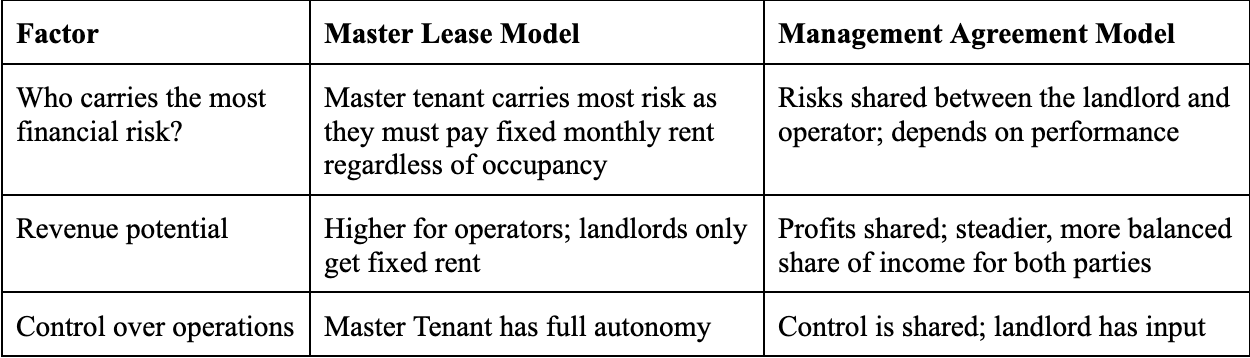
Master leases were once the most common way to create a formal deal structure between a property owner and a master tenant, until the pandemic’s impacts called for a new direction. Today’s work environments have placed a new and heightened emphasis on flexibility. Master leases were found to be inflexible with significantly higher risks and uncertainty. In contrast, with management agreements, profits and responsibilities are shared between landlords and coworking operators, being a more balanced and less risky approach for both parties. Therefore, as employees continue to demand flexible work options such as coworking spaces, deal structures must minimize risk, encourage collaboration, and be adaptable to this evolving trend.